
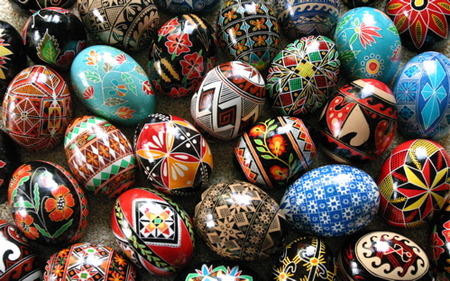
Everyone likes Easter eggs. What kind of eggs did you hunt this Easter? Did they look like this? Or maybe this?
![[Plastic Eggs]](https://upload.wikimedia.org/wikipedia/commons/5/50/Easter_Eggs_Plastic_Colors.jpg)
![[Ordinary Dyed Eggs]](https://upload.wikimedia.org/wikipedia/commons/c/c2/Easter_Eggs_by_Mystaric_on_Flickr.png)
Well, what if they looked like this?
![[Pysanky]](https://upload.wikimedia.org/wikipedia/commons/5/5b/UkiePysanky2006.jpg)
How to Write an Egg
Actually, they don’t exactly “paint”
them. They “write”
them. That’s why these eggs are called pysanky, from the word pysaty, which means to write
. (You pronounce pysanky as “PIH-sahn-kih”
, not “pie-SAHN-kee”
.)
How do you write on an egg? You use a special tool called a stylus. This kind of stylus, called a kystka, looks a little like a pen, but instead of ink, it writes with hot wax!
![[Styli]](https://upload.wikimedia.org/wikipedia/commons/f/f2/UkieStyluses.jpg)
Have you ever written on an Easter egg with a crayon, then dipped the egg in the dye? The dye colors the whole egg except where you wrote. This is the same basic idea.
So how can these eggs look so beautiful? First, the tip of the stylus is much more precise than a crayon. With practice, you can write designs in fine detail.
Second, each pysanka is dyed in several colors, not just one. Each “layer”
of colors has its own designs. First you write on the plain white egg. If you dye the egg yellow, you’ll have a yellow egg with white designs.
Then you can write new designs on the yellow egg. Then dye the egg orange. Now you’ll have an orange egg with both yellow designs and the white designs you drew first! You can keep adding designs and colors, from lightest to darkest, until the entire egg is covered with wax.
Last of all, you hold the egg next to (never above!) a lit candle. The wax melts away, revealing your beautiful pysanka.
Pysanky, Pisanki, Pisanice…
Many people in Eastern Europe use this “wax-resist”
method to decorate Easter eggs. But the word pysanky comes from the country of Ukraine. Ukranians are famous for their fabulous eggs. But their neighbors in other Slavic countries decorate their eggs as well.
In Poland, they call their decorated eggs pisanki. In Croatia, they’re pisanice. Like pysanky, these names also come from words meaning, “to write”
.
And there are other decorating techniques, too. You can paint with colored wax, or use make designs using onions, or leaves, or even straw!
![[Eggs decorated with colored wax]](https://upload.wikimedia.org/wikipedia/commons/c/cb/Velikono%C4%8Dn%C3%AD_vaj%C3%AD%C4%8Dka_malovan%C3%A1_voskem.jpg)
The Meaning of the Eggs
Everything on each pysanka has a meaning, both the “motifs”
(symbols and designs) and the colors. Some symbols are obvious, like the cross. Others might be hard to guess. Curls can mean “protection”,
but a symbol for the “protection of young”
is a the foot of a hen. Diamonds can mean “knowledge”
. But a triangle with a dot represents the eye of God.
Of course, you can’t read an egg like a book. Each color and many symbols have several possible meanings. And different meanings in different villages. Besides, there are several thousand folk motifs for pysanky!
But whatever else they mean, most pysanky also celebrate the same thing: that Jesus rose from the dead. An egg looks like a dead rock. But then a new, living chick suddenly breaks out. Every new hatching can remind us of when Jesus broke out of the rocky tomb.
![[More Pysanky]](https://upload.wikimedia.org/wikipedia/commons/8/81/VolynPysanky.jpg)
 A Catholic magazine for kids!


Leave a comment